Open-Source Software for High-Throughput Data Analysis in Research
High-throughput research generates massive datasets requiring sophisticated analytical tools to extract meaningful insights. Open-source software platforms provide accessible solutions for processing complex data across diverse scientific disciplines, from genomics through materials science. These tools handle large-scale computational challenges while maintaining transparency and reproducibility essential for rigorous scientific inquiry. The collaborative nature of open-source development ensures continuous improvement as research communities contribute enhancements addressing emerging analytical needs.
Key Features of High-Throughput Analysis Platforms
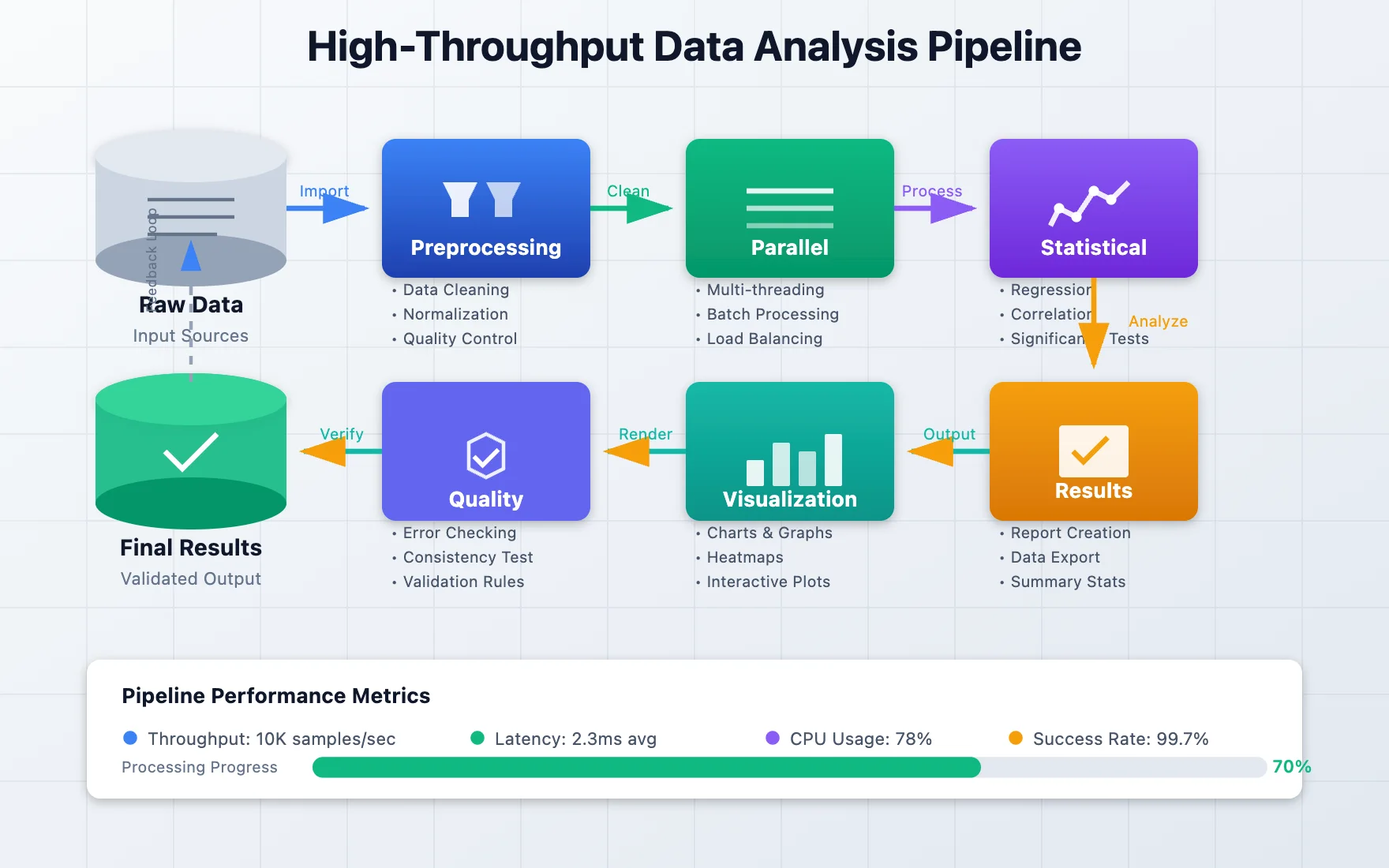
Effective high-throughput analysis software combines computational efficiency with comprehensive analytical capabilities. These platforms process millions of data points rapidly, apply advanced statistical methods, and generate interpretable results guiding scientific conclusions.
- Parallel processing capabilities distribute computational workload across multiple processors for faster analysis completion
- Automated workflow systems execute complex analysis pipelines with minimal manual intervention
- Statistical validation tools ensure result reliability through cross-validation and significance testing
- Visualization modules generate publication-quality graphics communicating complex results effectively
- Data integration features combine information from multiple experimental sources for comprehensive analysis

Software Platform Comparison
Various open-source platforms serve different high-throughput research applications with specialized capabilities.
| Platform | Primary Domain | Key Strength |
|---|---|---|
| R/Bioconductor | Genomics | Statistical analysis |
| Python/SciPy | General science | Flexibility |
| Open3DQSAR | Molecular data | Chemometric methods |
| KNIME | Multi-domain | Visual workflows |
"Open-source high-throughput analysis tools accelerate scientific discovery by providing researchers worldwide with sophisticated computational capabilities previously accessible only to well-funded institutions."
Applications Across Scientific Disciplines
High-throughput analysis software finds applications throughout modern research. Genomics researchers process sequencing data to identify genetic variants and expression patterns. Materials scientists analyze spectroscopic data characterizing novel compounds. Environmental researchers process sensor networks generating continuous monitoring data. Clinical researchers evaluate large patient datasets seeking treatment predictors. The common thread connecting these diverse applications is the need for robust statistical methods handling complex, high-dimensional data while maintaining scientific rigor. Open-source platforms provide the necessary computational infrastructure, enabling researchers to focus on scientific questions rather than software development while ensuring transparent, reproducible analytical methodologies.